
EU ETS & Mediterranean Trade: A Shipowner's Compliance Guide
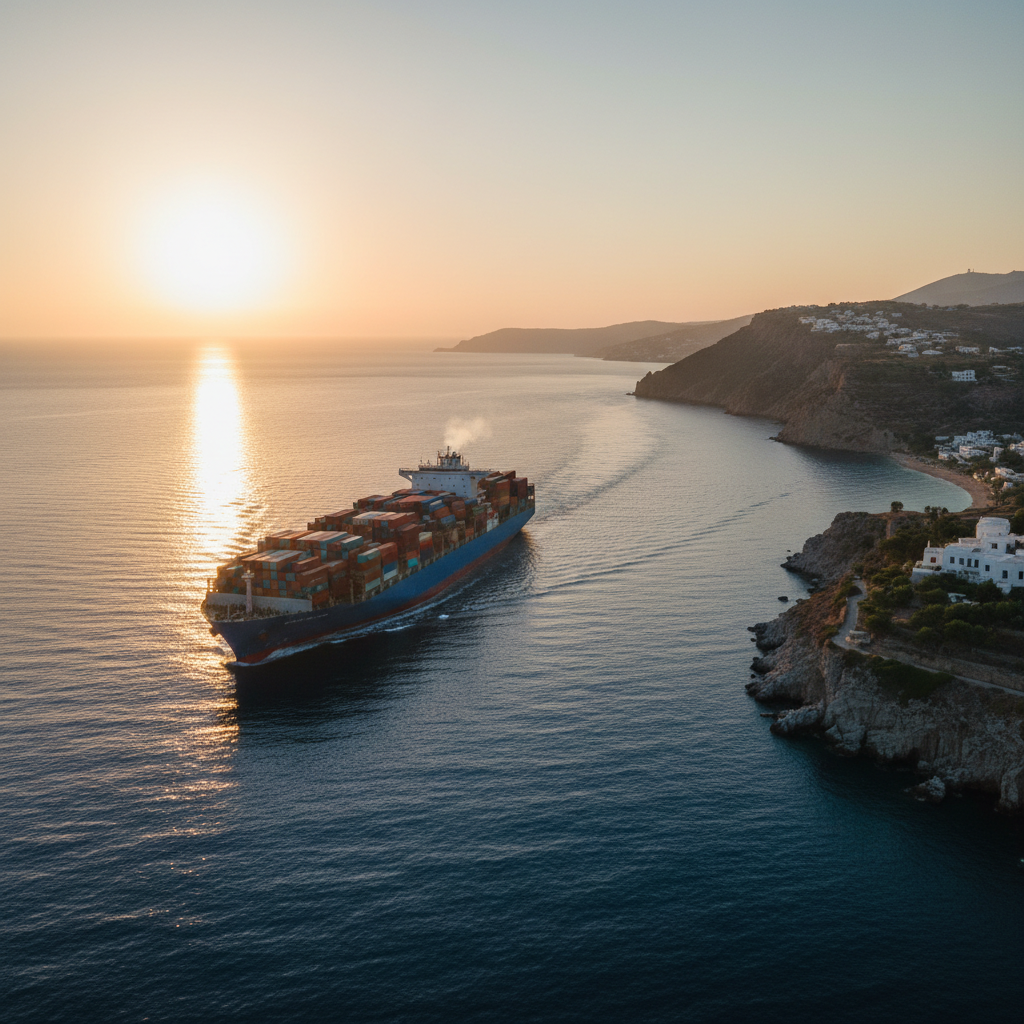
''' For shipowners and operators in Jebel Ali, Singapore, or Jeddah, the Mediterranean isn't just a market—it's a critical artery of global trade. But as of January 1, 2024, navigating these waters requires more than just expert seamanship; it demands sharp financial and regulatory acumen. The European Union's Emissions Trading System (EU ETS) is now a reality for shipping, and its impact onprofitability for voyages calling on ports like Valencia, Piraeus, and Genoa cannot be overstated.
This is not another high-level summary. This is a practical guide for fleet managers and technical superintendents, breaking down the concrete financial implications and outlining a clear compliance roadmap for vessels trading between the GCC, Asia, and the Med.
What the EU ETS Means for Your Med-Bound Fleet
The EU ETS functions as a "cap and trade" market. A cap is set on total greenhouse gas emissions, and companies must hold and surrender a corresponding number of "allowances" (EUAs) for their verified emissions. For shipping, this is being phased in:
- 2024: Surrender allowances for 40% of verified emissions.
- 2025: Surrender allowances for 70% of verified emissions.
- 2026 onwards: Surrender allowances for 100% of verified emissions.
The crucial detail lies in the voyage scope. For a vessel sailing from Singapore to La Spezia, Italy, the ETS applies to 50% of the emissions for the entire voyage. For any subsequent journeys between EU ports, say from La Spezia to Barcelona, 100% of the emissions are covered.
Let’s put this into perspective. Consider a 9,000 TEU container ship on a 20-day voyage from Jebel Ali to Valencia. Burning approximately 50 tonnes of VLSFO per day at sea, the vessel generates around 3,150 tonnes of CO2. For 2024, the surrender obligation is calculated as: 3,150 tonnes x 50% (voyage scope) x 40% (phase-in) = 630 tonnes of CO2. At a volatile but indicative EUA price of €65 per tonne, the carbon cost for just this one leg is €40,950. By 2026, this same leg will cost over €102,000 in carbon allowances alone.
The Financial Impact: Beyond the Price of Allowances
The direct cost of EUAs is only the beginning. The secondary financial implications require immediate strategic attention from leadership in Dubai and Singapore.
First, there is significant market volatility. EUA prices have fluctuated between €50 and €100 over the past couple of years. This makes it incredibly difficult to price voyages and hedge risk. A procurement strategy is essential—will you buy EUAs on the spot market, or will you use futures to lock in a price?
Second is the fiercely debated issue of "who pays." While the regulation places legal responsibility on the shipowner, new ETS clauses in charter party agreements are now standard. These clauses typically pass the cost of allowances onto the charterer. For fleet managers, this means meticulous tracking and transparent invoicing are non-negotiable to ensure these costs are fully recovered.
Finally, the EU has anticipated attempts to evade the regulation by calling at nearby non-EU ports. The legislation includes a "transshipment clause" monitoring ports like Tanger Med in Morocco and East Port Said in Egypt. If a shipping line uses these ports solely to transship cargo to an EU destination to avoid an ETS charge on the long-haul voyage, the system will still count the journey as if it went directly to the EU port, nullifying the benefit of the evasive call. This ensures a level playing field and brings more voyages into scope than a cursory reading of the rules might suggest.
Your Compliance Checklist: From MRV to Surrendering Allowances
Compliance is a multi-step annual cycle that requires rigorous process control. Errors or delays can lead to significant penalties, including a €100/tonne penalty for missing allowances and potential expulsion orders for repeat offenders.
-
Foundation: The Monitoring Plan: Every vessel must have an updated, verified Monitoring Plan compliant with the EU’s Monitoring, Reporting, and Verification (MRV) Regulation. This is the bedrock of your emissions reporting.
-
Administration: The Union Registry: Your company must be assigned to an Administering Authority within an EU member state and open a Maritime Operator Holding Account (MOHA) in the Union Registry. This is where you will hold and surrender your EUAs.
-
Execution: Track, Report, Verify: Throughout the year, you must accurately track fuel consumption and other data for all relevant voyages. After the year ends, this data must be compiled into an emissions report, verified by an accredited third party, and submitted by March 31 of the following year.
-
The Final Step: Surrender Allowances: By September 30, you must surrender the corresponding number of EUAs in your MOHA to cover your verified emissions from the previous year.
For a technical manager overseeing a diverse fleet, this process can be condensed into a clear action list:
- Confirm Administering Authority: Based on your port call frequency, identify which EU member state (e.g., Greece for Piraeus, Spain for Algeciras) will oversee your company.
- Update Ship-Specific Monitoring Plans: Ensure all plans are compliant with the latest MRV Maritime Regulation and verified.
- Open a Maritime Operator Holding Account (MOHA): This is the essential bank account for your carbon allowances. Don't delay this step.
- Implement Robust Data Collection: Move beyond manual noon reports. High-frequency sensor data, cross-referenced with bunker delivery notes, provides the accuracy needed to withstand verification audits and optimize performance.
- Develop a Procurement Strategy: Engage your commercial and financial teams. Decide on a clear policy for when and how to buy EUAs to mitigate price risk.
Strategic Implications for GCC and Singaporean Operators
This regulation changes the economics of shipping. Proactive operators will find opportunity in this shift, while reactive ones will face eroding margins.
Bunker planning is now intrinsically linked to carbon cost. The choice of where to bunker—whether in Fujairah's busy anchorage or out of Singapore—must now factor in the carbon liability for the entire Med-bound voyage. A slightly cheaper fuel price may be negated by a longer voyage that incurs a higher ETS cost.
Furthermore, vessel efficiency is paramount. An older, less efficient Panamax will now be significantly more expensive to operate on a route from Asia to the Med compared to a modern, eco-design vessel. A 10-15% improvement in fuel efficiency, once seen as a simple opex saving, is now magnified by the associated savings in carbon allowances.
This is where technology provides a decisive edge. An AI-driven platform can analyze high-frequency data to create a digital twin of your vessel, modeling its performance and fuel consumption with unparalleled accuracy. It allows a fleet manager in Dubai to not just see a vessel’s current fuel consumption, but to forecast its total ETS cost for a voyage in real-time, test different routing scenarios, and identify the precise moment to adjust speed for optimal fuel and carbon efficiency.
Proactive management starts with predictive insights. To see how Helmsman can model your ETS exposure and optimize your Med-bound voyages for fuel and carbon efficiency, explore our Fuel Optimization and Offshore Intelligence solutions. '''